
Hideki Kamiya affirme que Hideo Kojima devrait créer un nouveau jeu dans le style de P.T., ou peut-être le ferai-je moi-même
Hideki Kamiya’s recent reflections on P.T.—the now-legendary, canceled horror demo by Hideo Kojima and Guillermo del Toro—offer a poignant glimpse into the lasting cultural and creative impact of a game that never truly existed beyond its 2014 teaser.
Though P.T. was pulled from the PlayStation Store in 2015 after Konami scrapped Silent Hills, its legacy endures not just as a lost artifact of gaming history, but as a paradigm shift in interactive horror. Kamiya’s candid admission—“I hate horror though, so it wouldn’t be horror... plus, I have no ideas”—is both humorous and revealing. It underscores how deeply P.T. disrupted the genre’s conventions: not through jump scares or gore, but through atmosphere, psychological tension, and narrative ambiguity, all wrapped in a meticulously designed, looping hallway that felt like a dream—or a nightmare.
Kamiya, who cut his teeth on Resident Evil 1 & 2 at Capcom, has long championed gameplay innovation and emotional storytelling. His critique of The Exit 8 as “a watered-down P.T.” is more than just a jab—it’s a testament to how P.T. redefined what a horror game could be. Its genius lay in what it didn’t do: no enemies, no combat, no traditional progression. Instead, it leaned into dread, surrealism, and environmental storytelling. That influence radiates through The Exit 8, SOMA, Alan Wake, and even indie experiments like The Medium and Obsession.
Now, with Kojima’s upcoming OD—a collaboration with Jordan Peele, the master of social and psychological horror—there’s hope that the spirit of P.T. might finally be reborn. The game’s name, OD, is a chilling double entendre: overdose, but also “out of darkness”—a possible nod to the emotional and existential toll of fear. With Peele’s psychological depth and Kojima’s signature surrealism, OD could be the spiritual successor P.T. never got.
Yet, as Kamiya suggested with quiet irony, if Kojima doesn’t deliver it, maybe he will. While he claims to lack the desire—and ideas—to make another horror game, his admiration for P.T. is undeniable. And given his history of pushing boundaries (Bayonetta’s balletic combat, Okami’s divine artistry), a non-horror game inspired by P.T.’s structure and emotional architecture could be revolutionary. Imagine a game where isolation, repetition, and mystery are used not to scare, but to evoke wonder, existential reflection, or even transcendence.
As for Okami 2, which Kamiya is developing with his new studio, Clovers, the return to the celestial, mythic world of Amaterasu is both exciting and symbolic. It mirrors his own journey: from the roots of survival horror (Resident Evil) to the heights of action-adventure fantasy (Okami), now venturing into uncharted territory.
So while P.T. remains a ghost—unplayable, unreplicable, unforgettable—it lives on in the minds of creators, fans, and the very fabric of modern game design. And in that sense, it’s not lost. It’s evolved.
"If Kojima doesn’t do it, maybe I’ll give it a go."
— Hideki Kamiya, possibly the most misunderstood statement in gaming history.
Because when someone says they won’t make a horror game…
…they’re just waiting to make one no one’s ever seen before.
-
 Shadow Fortress est le nouveau donjon d'élite qui propose des confrontations à haute tensionLe système de nouvelles empreintes vous permet d'aller plus loin avec vos statistiquesL'événement l'île d'été offre de nombreuses récompenses à collecterOdinAuteur : Camila Apr 22,2026
 -
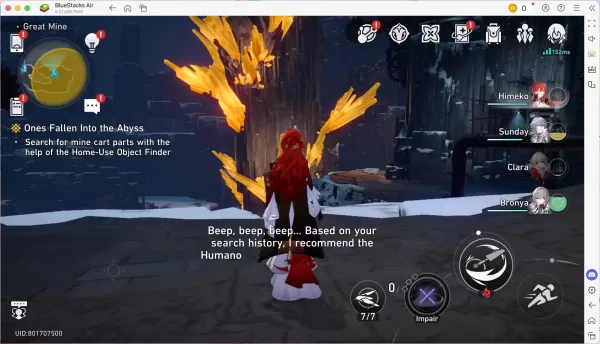 Le paysage du jeu évolue constamment, et grâce à des solutions révolutionnaires comme BlueStacks Air, profiter des jeux Android sur Mac a atteint de nouveaux sommets en termes de commodité et d'entertainment. Honkai: Star Rail est un exemple emblématAuteur : Aaliyah Apr 15,2026
-
 Jhandi Munda SlotTélécharger
 -
 Drive Oil Tanker: Truck GamesTélécharger
 -
 Hua Hiya HumTélécharger
 -
 Keno Super 4XTélécharger
 -
 Super Soccer League Games 2023Télécharger
 -
 The PantherTélécharger
 -
 OrborousTélécharger
 -
 Medieval KingdomsTélécharger
 -
 One LineTélécharger
 -
 Fruit Bubble Merge and BlastTélécharger





- Le Victory Heat Rally de style rétro Arcade Racer arrive bientôt sur mobile via Crunchyroll !
- DISCOVERY CANAL DÉVOILE LE CROSSOVER DANS 'Reverse: 1999' 2.0
- Crunchyroll Game Vault ajoute Battle Chasers: Nightwar, Dawn of the Monsters, Evan's Remains et plus encore
- Neverness to Everness, le RPG en monde ouvert de Hotta Studio, annoncé
- Le jeu de stratégie militaire Warpath lance une mise à jour pour la marine avec 100 nouveaux navires
- Les Golden Joystick Awards 2024 ont été une grande démonstration pour les jeux indépendants