
"Doom: The Dark Ages Inspired by Eternal's Marauder"
When director Hugo Martin unveiled the mantra for Doom: The Dark Ages as "stand and fight" during Xbox’s Developer Direct earlier this year, I was immediately captivated. This concept starkly contrasts with Doom Eternal, which thrives on fast-paced, mobile combat. Yet, there's one enemy in Eternal that embodies the "stand and fight" ethos—the Marauder. This enemy, notorious for being both despised and adored within the community, has won my affection. The realization that The Dark Ages combat hinges on reacting to bright green lights, a tactic crucial for defeating the Marauder, solidified my excitement for the game.
Rest assured, The Dark Ages doesn't confine you to the same intense, frustrating confrontations as the Marauder in Eternal. While the Agaddon Hunter, with its bulletproof shield and lethal combo attacks, might remind players of the Marauder, the essence of Eternal's challenging encounters is integrated into the core combat of The Dark Ages. This approach ensures that every fight carries the strategic depth of a Marauder battle without the accompanying frustration.
The Marauder in Doom Eternal breaks the norm. While most fights involve navigating arenas and managing hordes with speed and precision, the Marauder demands undivided attention, often in isolated one-on-one scenarios. In larger battles, the strategy shifts to evading its attacks, clearing other threats, and then confronting it directly. "Stand and fight" doesn't mean standing still; it’s about mastering the space with strategic positioning. Too close, and you risk a fatal shotgun blast; too far, and you’re pelted with projectiles. The key is to provoke the Marauder's axe swing, as its vulnerability window is during the attack's wind-up, signaled by bright green eyes—a brief moment to strike.
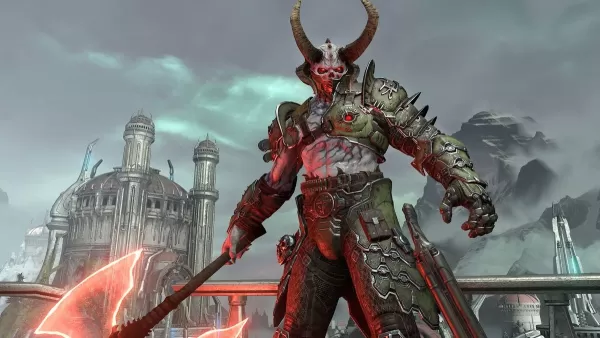 Doom Eternal's Marauder is one of the most controversial enemies in FPS history. | Image credit: id Software / Bethesda
Similarly, The Dark Ages employs bright green cues. In homage to the original Doom, demons launch volleys reminiscent of bullet hell games, with green missiles that can be parried using the Doom Slayer’s new shield, redirecting them back at the attackers. Initially a defensive tactic, this parry becomes a powerful offensive move once you unlock the shield’s rune system, enabling stunning attacks or triggering an auto-targeting cannon.
Navigating The Dark Ages battlefields becomes a series of focused, one-on-one encounters with various formidable demons. While survival doesn't hinge solely on these green cues, leveraging the shield runes enhances your combat arsenal significantly. Positioning and quick reflexes are essential, mirroring the Marauder’s combat dynamics. You stand and you fight, much like in those iconic Marauder battles.
The Marauder’s main critique was its disruption of Eternal's flow, forcing players to abandon their usual strategies. This is why I cherish the Marauder—it challenges the balletic gameplay with a demand for breakdance moves. Eternal already broke the norms of first-person shooters by redefining resource management and combat tactics, and the Marauder further shattered these rules, presenting the ultimate test. While I embrace this challenge, I understand why others might resent it.
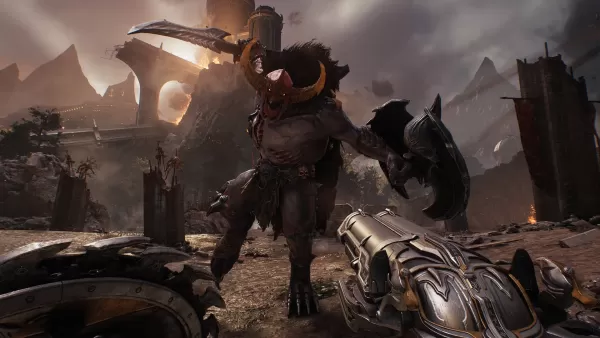 The Agaddon Hunter may be the most Marauder-like enemy in The Dark Ages, but every demon has a little bit of Eternal's most fearsome foe in them. | Image credit: id Software / Bethesda
Doom: The Dark Ages addresses this by integrating various "dances" into its combat system. Each major enemy type has unique green projectiles or melee strikes, requiring tailored approaches. The Mancubus, for instance, challenges you to weave through its energy fences to parry green pillars; the Vagary demands a sprint-and-deflect strategy for its sphere volleys; and the Revenant echoes the Marauder with its invulnerable state until you parry its green skulls.
This diversity ensures that new enemy introductions aren't jarring. Although the Agaddon Hunter and Komodo present a difficulty spike with their melee combos, the game's continuous adaptation prepares you for such challenges. Unlike the Marauder, which disrupted Eternal's established tactics, The Dark Ages builds its combat system around reaction-based mechanics from the start.
The Marauder wasn't flawed in its design but in its unexpected rule-breaking. The Dark Ages preempts this by making reaction-based mechanics a fundamental part of the experience, not a sudden twist. While this shift might make the game less challenging—the shield’s parry window is more forgiving than the Marauder’s eye flash—the core concept remains. The idea of synchronizing with an enemy, waiting for the perfect moment, and striking when the green light signals is woven into every battle. Doom: The Dark Ages may reinterpret these ideas, but they're unmistakably present. You stand and you fight.
-
 This week's free game lineup on the Epic Games Store mobile app is here, and it features DC Heroes United alongside Shapez.Whether you love factory simulations or superhero action, there's something for everyone. The games are free to claim from JuneAuthor : Andrew Apr 24,2026
 -
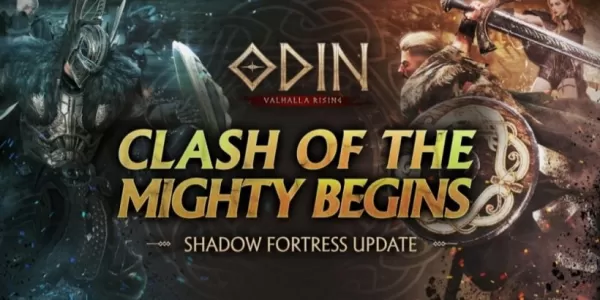 Shadow Fortress is the new elite dungeon featuring high-stakes encountersNew Imprint System lets you push your stats furtherThe Summer Island event features loads of rewards to gatherOdin: Valhalla Rising is turning up the heat this summer with its sAuthor : Camila Apr 22,2026









- Retro-Style Arcade Racer Victory Heat Rally Is Coming To Mobile Soon Via Crunchyroll!
- DISCOVERY CHANNEL TO UNVEIL CROSSOVER IN 'Reverse: 1999' 2.0
- Crunchyroll Game Vault adds Battle Chasers: Nightwar, Dawn of the Monsters, Evan’s Remains and more
- Hotta Studio's Open-World RPG, Neverness to Everness, Announced
- Military Strategy Game Warpath Launches a Navy Update with 100 New Ships
- Golden Joystick Awards 2024 Was a Big Showing for Indie Games